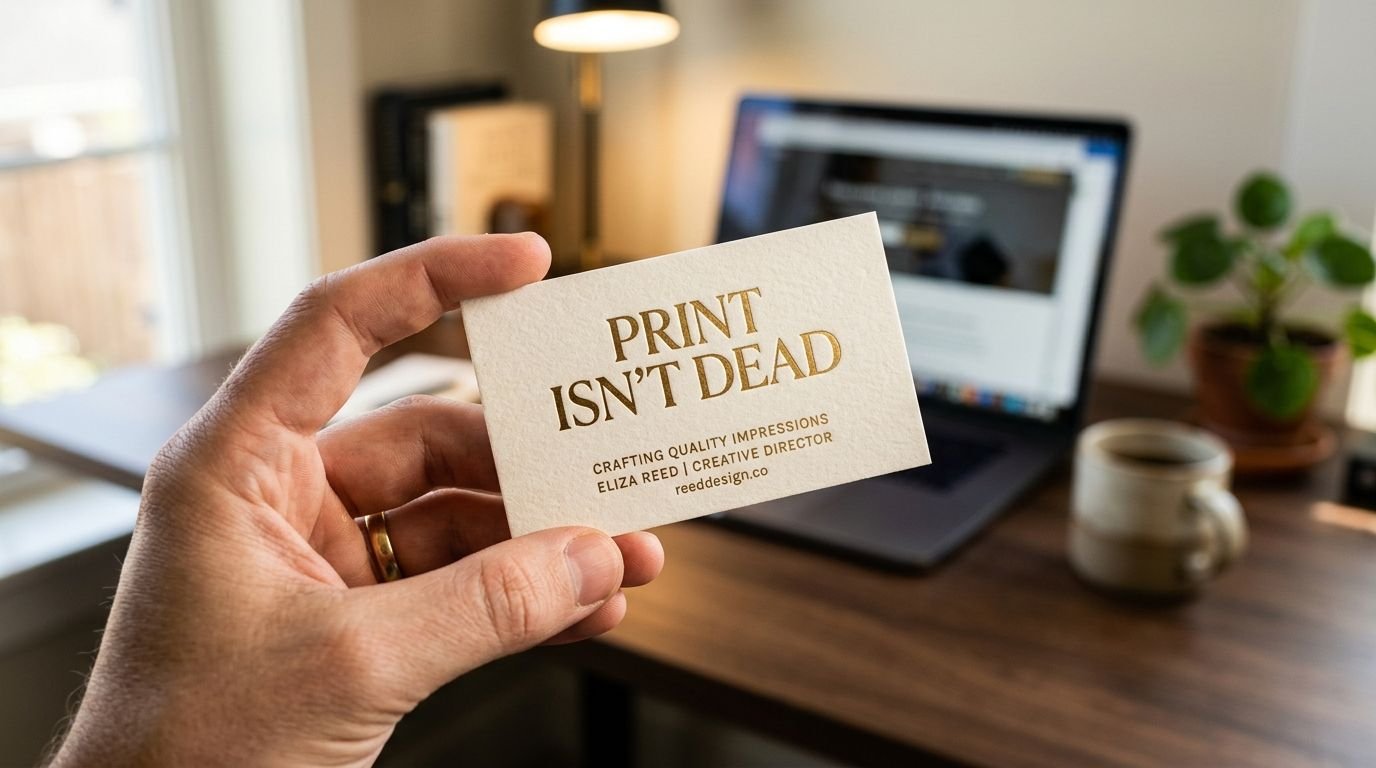
Every few years, someone declares print marketing dead. Every few years, it quietly proves them wrong – because physical marketing does something digital can’t: it occupies real, tangible space in someone’s hands or their environment.
Attention is scarce online, abundant offline
A social post competes with hundreds of others in the same five-minute scroll. A well-designed brochure sitting on someone’s desk, or packaging sitting on a shelf, doesn’t have to fight for attention the same way – it simply exists, undistracted, until it’s picked up.
Print signals permanence and trust
Business cards, printed signage, and professionally designed packaging still carry a credibility signal that a website alone doesn’t fully replicate – particularly in markets where in-person relationships and trust still drive a large share of business decisions.
Packaging is marketing, not just protection
For product businesses, packaging is often the single most-seen brand asset a customer interacts with – more than the website, more than any single ad. Well-designed packaging does double duty: it protects the product and it sells the next purchase.
Print pairs with digital, it doesn’t compete with it
A QR code on a flyer, a branded thank-you card in a shipped order, signage that reinforces a social handle – the most effective use of print in 2026 isn’t standalone, it’s the physical half of a strategy that also lives online.
The businesses getting the most out of print aren’t choosing it instead of digital. They’re using it for what only print can do: sit in a hand, on a shelf, or on a wall – quietly working, with zero algorithm deciding whether it gets seen.